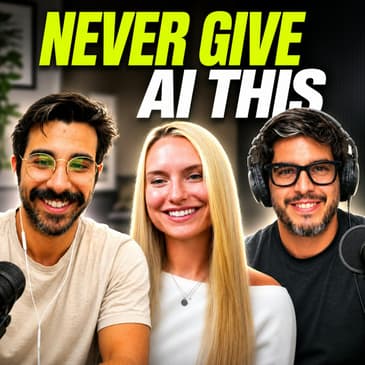
Lindsay Rosenthal has 50,000 followers on LinkedIn and makes content alongside OpenAI, HubSpot, Atlassian, Descript, and LinkedIn itself. So when she told us she currently uses zero AI for her ideas... and stopped using it for her scripts and copy entirely... we stopped the conversation and made her explain. What she said next is the whole episode. There's a specific reason AI can make you competent and almost never makes you the best, and once you hear it you can't unhear it. We also got into the exact 30-day plan for someone sitting at 500 followers right now, why commenting is the most underrated sales activity on the internet, whether you should tell people you used AI, and the story of a guy who built a business on AI avatars and shut it down after a conference. Oh, and Fonzie's back. He brought the Waffle House rule. 👉 Grab your free context document at www.businesscreator.club
Chapters: 00:00 What's coming in this episode 00:52 Fonzie's back and the LinkedIn queen is here 01:58 Boston, Unbound, and the AI talk we're doing together 02:25 Why LinkedIn is the platform nobody's posting on 03:39 Going all in on video before anyone else was 04:24 The six months before it worked 05:33 The system behind posting every single day 06:47 The content bank and the once-a-week film day 07:44 How she tells a good idea from a bad one 09:06 Fonzie's $5 filter 09:56 Creating content is a skill... and it's embarrassing at first 10:49 Our 45 days of Facebook Lives (we made it 15) 12:08 What changed when she started working with the AI companies 12:59 She uses zero AI for ideas 13:25 The exact way she uses AI on scripts and copy 15:02 Where AI actually belongs in ideation 16:00 Talking your way to ideas 16:33 MCP and why context is the real unlock 17:51 Fonzie's gap analysis for YouTube 20:23 The right way to use AI (and the laziest way) 21:00 The hot take: the jobs marketers gave AI 21:33 The fully AI episode we published 23:35 The junior editor experiment 25:19 The Football Show: 30 episodes, Claude, and Descript 26:28 Why Fonzie uninstalled it in one day 28:11 Should you disclose that you used AI? 29:11 The trust question nobody wants to answer 31:22 The handmade scarf 32:40 The AI avatar story that ended a business 34:32 AI is trained on the average of the entire internet 35:55 Fonzie's cooking rabbit hole 38:46 Why your skill level changes what "good" means 40:33 Case study: 500 followers, 30 days, go 41:08 Three pillars... content, comments, connections 43:02 Is all that commenting actually worth it? 43:43 The reframe: comments are outreach, not growth 44:37 The Waffle House rule 45:52 The soccer comment that got 200,000 views 48:13 Don't think about it as selling 48:38 Brand deals versus agency work 50:03 Inbound or outbound? 50:57 Boston, part two, and where to find Lindsay 53:19 Close
[00:00:00] Hey guys, welcome to the show and today we have a special treat. We're back with guests and heavy weight guests because we're going to be on Unbound at the end of September or mid-September and Fancy, she is the one that's going to be on stage with us talking about AI, how to make money with AI, how are people doing it wrong today.
[00:00:18] She was able to build her own audience up to 50,000 followers on LinkedIn and that exploded her business. So we had a very cool, you know, unfiltered conversation about all things AI, including the Waffle House rule that Fonzie brought at the end of the episode. Super cool. But anyways, you will enjoy this episode. I'm so stoked that we have guests back. So, you know, sit down and enjoy the episode, baby. Here we go.
[00:00:45] Hey guys and welcome to Content Is Profit. We have here the LinkedIn queen, Lindsay. Let's go. You've heard all her accolades, all the things right before. Lindsay, you're the first guest back in Content Is Profit in quite a bit. I was able to wrangle Fonzie to come back to the show. I think we ran over 150 episodes without him. So now people are like, who is this guy? And now we have guests and people are like, wait, you guys interview guests?
[00:01:11] And what a better way to bring you the AI, LinkedIn queen, all of the content stuff. And we have a little teaser that we'll announce in just a bit. But Fancy, welcome to the show. Thank you so much. It sounds like we have another special guest Fonzie here too. So I'm happy to be back on the reunion show. Hey, he's been crushing the episodes lately. I've just sat and learned from him. He's like, dude, I need to talk about this. And it's like, awesome. Let's go do it.
[00:01:41] It's been a year and a half. I said that, you know, so all that knowledge has been contained now to share with the world. Yeah. So Fancy, we connected, obviously, we're going to be doing a presentation together at Unbound in Hotspot in September. Let's go. I think it's the day after my birthday. So we're going to be celebrating in Boston. So if you're in Boston, if you're listening, come hang out with us.
[00:02:03] Let's go. And we're going to be talking a little bit of AI. So we've been able to kind of, you know, sync up and share a little bit of thoughts, but not really going deep because I was like, let's leave it for the show. And you collaborate with massive brands, OpenAI, Descript, Hotspot, obviously, Atlation, like all these like crazy, amazing things. And you've been able to build this incredible community and following in LinkedIn specifically, correct?
[00:02:32] Yes, LinkedIn. It's my main platform. And I feel like everyone like has what like LinkedIn, but yes, it's the place to be. The place to be. So why do you say it's a place to be? Yeah, I so I started creating on LinkedIn, like maybe four or five years ago. At the time, it was a place you go to to get hired. And it was really not a place people post content. But since then, it's really, really erupted. And it's been fun, like behind the scenes talking to the LinkedIn team.
[00:03:00] They've had a lot of more focus now on like the creator features and everything around like the creator economy. I feel like we all saw TikTok really blow up back in COVID. And I feel like LinkedIn is just kind of on its own roller coaster ride right now. And it's really exciting place to be because it's just a new spot. People share interesting new type of content all around marketing and AI.
[00:03:22] It's all blowing up on its own, but very interesting platform that so many people spend time on, but not so many people post content on. Yeah, that's that's really cool. And, you know, we've heard any comments where it's like, it's just like Facebook. Like he used to is like, he's turning into Facebook, all these things. And, you know, you went in on video. Most of your things, you know, you're publishing is video. And we often hear advice in the industry where it's like, you got to write a newsletter or maybe some posts.
[00:03:51] Like they try to make up this this context about, you know, what to do on LinkedIn. And I think we're more in the school of like create low friction to your own process and then like test, obviously. And, you know, learn from that and adapt. But obviously you may read your main thing in LinkedIn if you want to share a little bit of like how that experience has been. And like what are the six months before it actually worked that you felt like it blew up? Like how was that like? Yeah. So I started my own content agency back in college.
[00:04:20] So at the time had no followers, not so many clients and not a lot of trust because I was super young in industry and I hadn't worked with a lot of brands yet. And so I started posting video content daily every single day on LinkedIn. And it has been the biggest growth level or like the biggest learning, the biggest credibility builder in the entire industry, being able to post daily video on LinkedIn. Because that's how you go. I got my clients, how I go do everything.
[00:04:48] And so it's been just a unique place to start posting video. And I feel like the six months before I was posting my own video content, I was actually creating video content for execs. We were doing podcasts and all sorts of things. And I was like, wow, this is really working for these execs. I'm already capturing a lot of my video. I was like, I should start posting it onto LinkedIn. And I've learned so much on like what works, what doesn't, things that capture attention.
[00:05:13] Like the industry has changed so much, even especially with AI and using those type of tools to create content. But it's been a roller coaster to say the least, but I've learned a lot along the way. I'm curious, right? Somebody is like, I want to be like Lindsay. I want to post every single day. I'm sure you have a system, right? To make that happen. I'm sure you don't just wake up and be like, let me grab my phone and make a masterpiece out here. Right? So can you share a little bit of that system? So somebody can potentially achieve what you've done. Yeah.
[00:05:44] Yeah. I mean, it's definitely a system and it's a lot of discipline as well. It's become, I think, I think part one is just creating the habit around it. It's something that without a doubt, I have content going live every single day. And I think it's this, it's the same idea as like, I know we all have sports background. It's like, you're working out every single day. It's just something that you do. And I think once you make it a habit and a standard for yourself, it's easy to flow and easy to build a system around that habit and that standard. So once I'm like, okay, I'm posting every single day. This is, I work out every single day.
[00:06:13] It's just something that you do almost as if you're brushing your teeth. This is like standard. Then you can kind of build a system around it. And the system, I feel like it's different for everyone. But what works for me is I have some sort of content bank where I'm throwing ideas into it all the time, whether it's just, I built some like cool tools around it or whatever I have up at the time, but I have some sort of content bank that I'm just always throwing ideas in. And I usually sit down once or twice or maybe more a week to film or create the, like the
[00:06:43] photos or the images or whatever that I'm doing. And I kind of sit down and film once a week. And then from there being able to, I have an editing team. So usually I'm throwing my videos and all this stuff their way. I'm giving feedback or I'm making like the carousels myself. So I sit down, create once a week, give it to my team. But then along the way, I have different ways that I use AI and don't use AI too with all of my ideas and even some of the initial creating.
[00:07:11] I don't use AI a lot of times in those process too, just to make it more me and not so AI generated. And so I think it's kind of a flow of a having a habit, making it a discipline around it and then be kind of creating weekly. And then having my team slash some different AI systems that I use to like help it kind of keep going and creating around that. Yeah. I'm curious on the terms of, on the part of ideas, because I believe that that's where
[00:07:39] it starts, where like a good piece of content differentiates from anything else is the idea. So I think the ability to have a lot of ideas gives you the benefit of selecting the best ones. But how do you select those? How do you distinguish between, I think this idea is going to knock it out of the park or, you know, maybe this one's going to flop. I'm not going to put my, you know, I'm not going to invest my resources in this one. Yeah. Yeah.
[00:08:05] I think any type of content that actually like goes from beyond idea to creation is something that I genuinely myself would want to consume. Is this a piece of content that a has a good hook, a has a good beginning, has a learning, has something unique, something that's helpful for me either as a learning in my own business where I had to figure something out and like, Oh wait, this is actually interesting. I had to figure this out. I'm going to give it to a piece as a content for someone to use, or it's just a piece of
[00:08:31] content that like I saw an idea for, or a hook or something like that. I feel like any piece of content that I'm creating is something that I generally find interesting or entertaining. So either educate or entertain from this piece of content. And if it doesn't pass like that vibe or that flow, then I'm not creating it. It's boring and it's not going to land with my audience. I like it. I think it's a, it's a really good filter.
[00:08:57] You know, I often, when I'm talking to people about their content and just kind of like diving deep and analyzing their stuff, uh, that's one of the things I tell them is like pretty much would somebody pay $5 for this thing, right? Like, is it that valuable? If yes, sure. Put it out there, right? If it's boring, you probably don't want to put it out there. And that doesn't mean that you have to just be a clown and like be super entertaining. Right. But like, it's all about also the energy that you share inside of your content.
[00:09:26] And I can tell by watching some of your videos, like not sure. I don't want to say you're a natural, but like you can clearly tell you've done it for a long time because it feels legit. And now talking to you. She was a freshman captain Fonzie. Of course she's a natural dude. What are you talking about? She's a leader. She's a leader. I'll say it's like as same as sports reps, practice, coaching, learning. Like, I don't think I would want to go back and go through watching my first videos myself.
[00:09:56] Like I see clips every once in a while, like pop up my camera roll. And I'm like, it is learning. It's a skill. Creating content is so hard. It's a skill like being natural on camera. And so many people I work with are some of the most interesting people in the industries, like PhD researchers from Stanford or like CEOs of companies. Like these people have so much interesting information, crazy things that I want to learn
[00:10:23] from about, but it's just a practice getting them on camera and like delivering it in an interesting way because it's, it is hard. It is hard and it is embarrassing and it is just not an easy thing to like create content. Yeah. It's a, it's a, it's a brand new skill. They don't teach you anywhere, right? Like at the end of the day, I think a lot of the entrepreneurs and people that have shows and podcasts and things like that, or even create content on their own. It's like, how do I figure this out? There's a guy on Instagram.
[00:10:51] I follow, I think his last name is Dean, but he, he teaches people how to speak on stage. And he is, his content is pretty interesting, but he was a magician. He was like an introvert. And he's like, dude, I got, I, he shares his story on how he had to do that kind of stuff. And for us too, like if we see now the first podcast episodes that we've already recorded is hilarious, right? And at the end of the day, it's like, Hey, how can we be that 1% better on the next piece of content?
[00:11:18] And I think your story with daily content is so interesting because, and we relate, right? Like we unlocked publishing when we decided to do 45 days of straight Facebook live content. And that's where our community was at the time. That's how we decided, did we do 45 days? No, we did 15. And then we stopped because, you know, luckily we connected with somebody and then we got everyone with work. And then we're like, okay, let's rebuild the system. And we did it again. And then we did it a third time.
[00:11:46] But it's like that crazy commitment where it's like, how can we put in the reps? And it doesn't have to be a full hour podcast every day. It could be a one minute clip. It could be a two minute clip right at the end of the day. So, um, I guess like my next question there after building your system and you're starting to create this now, you obviously make content alongside like the best and biggest companies in AI, right? Uh, I'm, I'm assuming you've had conversations that are pretty interesting, maybe behind closed doors.
[00:12:13] How has that really changed the, the, like the way that you personally work? Cause there's a lot of people that consume the show that are now experimenting with AI. We jump on our business creator clubs, Q and A. And like today, almost every single question in office hours is about AI and building with AI and doing these things. And, uh, so I'm very interested with, you know, your proof. Also, you say most people use AI wrong, which is a lot of what we're going to be talking about in Unbound, right?
[00:12:42] How has that changed your workflow and how you work with content specifically? Yeah. I mean, I feel like my workflow and using AI has changed just, I say it changes on the monthly right now. My current system. I use zero AI for the idea. And I even stopped using AI for my script and my copy. Um, and I think that has been just. Team Fonzie. Fonzie team Lindsay.
[00:13:12] Oh yeah. And in the past, I used to like draft. Usually sometimes I would even draft with it and then tweak it. And I've like totally gone against that now. Now I'm not drafting with it. I'm not creating my script with it. I'm literally, let's say, for example, I've done some cool pieces with LinkedIn. If I'm, I'm, what I'm doing myself is I'm myself reading the whole brief and I'm sitting there and like, because I've created a lot of content and also we've all consumed a lot of contents. We know what content's good.
[00:13:39] I will type in to the AI and say, okay, here's my script. I want exactly this. I want you to use my voice. I don't want to change it. Um, and I give it the whole script as, as if I'm talking to my sister or my friend and doing script and I'll type it into the AI and then I'll put the brief into it. And I'll say, here's the brief for the, um, for this campaign. Just make sure I'm not missing anything. Make sure there's not one feature that I'm like really supposed to lean in on that I missed it.
[00:14:09] But here's exactly how I want the script to be. And then, and then AI gives, okay, the script's great, but you miss, you really need to hone in on like the value point of this one part of the feature. And I'm like, okay, great. So then I added in and I'm not even tweak it again and say, no, I want it in this vibe versus this vibe because then it comes back and it gives us like terrible sentence pair or like AI phrase or I'm like, I absolutely hate that. And then I do the same thing with my copy. Like I'm writing my initial hook, my initial thing, I'm writing it out and I just say, okay,
[00:14:38] please tweak it. So it just doesn't sound terrible. Like it doesn't sound like so unprofessional, like tweak it so that it like is maybe spaced more nicely. So that's. Sorry, Fonzie, I'll let you hug the mic in just a second. But you, Fonzie said that obviously idea is the most important thing probably to do this. And, you know, we, we consume a lot of YouTube content. We love, I personally love a lot of entertaining content. So a lot of those ideas, you can see it physically on, on those specific videos with business
[00:15:07] content might be a little bit trickier maybe. What's your, what's your process on ideation? Because I think ideation is one of the faces of content that we talk about all the time that people might be able to lean in more on, on AI to like unlock new ideas. Right. So I'll give you an example on our side. We use like the guest podcast episodes to grab ideas from that. We'll be like, Hey, you know, Lisa say this thing, this thing, this thing, maybe we can
[00:15:34] create videos or pose or newsletters about that one specific idea. We hop on, you know, office hours. Those are some of the ideas. Like what is your process? If you are not using AI to then move that content forward. I'm a big believer of like grabbing transcripts. Another thing that I really like doing too is using like whisper flow, for example, and talking into the, if I'm, if I'm just like coming up, trying to come up with more ideas.
[00:16:00] I love the idea of like talking into the AI and just like blabbering and blabbering. Cause as you're talking, you actually kind of come up with more ideas and then having it break down and give those ideas. Another thing that I've really been obsessed with too, and I think is kind of really the future of technology. And I'm, I would love to hear kind of your thoughts around this too, but the whole idea of MCP and connecting the tools you use in your work to claw to open AI, I think is a really huge level up because it just gives your AI more information. That's your unique one.
[00:16:30] For example, you can connect your meeting notes, whether you're using like granola or whisper flow or any of that into clawed. And so from there I can say, instead of like going over to whatever you're using for meeting notes and copy and pasting, you can just ask AI and be like, Hey, I had seven back-to-back calls yesterday and they all had really interesting information. And tomorrow I'm filming. So is there any unique things that you can pull from my meeting notes yesterday that are
[00:16:55] just trends that you're seeing a lot of, and then also help me kind of draw parallels behind all that content about what I'm saying with people in the calls are saying, is there anything that I'm talking about? That's just not actually so apparent and actually really interesting in parallels that I'm not picking up. And then having it grab all seven of these transcripts and like making this cool piece of information that I can then turn into short videos. And so I love like your idea of taking transcripts and then taking it as far as even having it
[00:17:25] all integrated into my open AI or my clawed and like grabbing those pieces. I think that's really, really cool. And I would love to hear kind of you guys are doing similar stuff along those lines. Yeah. I'm a yes to that question. I'm going to share a little bit of it here in a second, but I want to relate this to actually two episodes ago, we kind of talked about a framework that we have on trust, right?
[00:17:50] And as we're talking right now on ideation, I'm thinking the best ideas come from proximity to your customer, right? From those conversations, they're going to be telling you, you know, what their problems are, what they're struggling with. And one of the elements on that framework for trust was empathy, right? Like really understanding your ICP, right? Like really understanding that person that you're trying to help. So, so I love how now you're using, you might listen to my daughter here in the background.
[00:18:19] She, she likes this. And we now we'll see a podcast too. You're good. So what I'm saying is these AI tools, we can definitely use them to better evaluate this conversations and like the proximity elements to our avatar to create better ideas. Now, to answer your question, are we doing something similar? Yes, actually I call it like kind of like a gap analysis, but for ideating on YouTube as well, right?
[00:18:47] We look at some of the competitor videos for some of our clients and get the transcripts of all of them. And then we ask the same things like, Hey, what are these ones missing? Like, what are the points that they're missing in here that maybe we can double down? We can elaborate on all that stuff, right? Grab the comments from those videos. And it's like, Hey, what is the conversation happening in here? What is the main complaints, right? The objections or what is the thing that they like the most?
[00:19:16] So now we're able to, if we're going to base a video on a specific topic that maybe has been covered by some of the other people around, we can actually go deeper and rank better and have our video being recommended because again, it's more complete, right? It actually answers some of these objections that people are having. So we're using it in that way. I do love the idea, like you said, right? Connecting the platform through MCP, right?
[00:19:44] Connecting it to and giving it more context, right? To Google Drive or your conversations and using that to generate, I guess like some pointers, not generate the idea per se, but generate some pointers that can help you think of, okay, I think this could be a potential good idea. And by the way, I love the fact that you write everything yourself, you do everything yourself and then use AI to kind of like bulletproof that idea.
[00:20:13] Hey, am I missing something here, right? If you are, they have context of your audience, right? And you ask it, if you're my audience and you see this, what objections would I raise, right? Or what would maybe the key takeaways would be from here that I could expand on? So I think that is actually the right way to use AI and not give me five ideas for this. The last thing you can do. Yeah.
[00:20:40] My hot take too, is I feel like marketers over the past couple of years have given jobs to AI that AI should literally never do and steered away from giving jobs to AI that it should be doing. Like, like huge transcripts and like breaking it down to your own ideas. My take, my question for you guys is, is that like, what are the couple jobs that AI should literally never do?
[00:21:06] And then what are some of the jobs that you found that AI does the absolute best? Oh, okay. I like this one. First, well, Fonzie will be like, no AI ever. Uh, not, not like that either. We've been slowly, he is slowly turning him into this. And you know, I, I share the story with you about the episode that we did. That was fully, I was like, dude, listen to the episode. I want to hear your thoughts. Listen to the episodes, please. And he was like, that was pretty decent.
[00:21:36] And I was like, yeah, let's go. By the way, for, if you're listening and you have no idea what I'm talking about, go back a couple of episodes and you'll see the one that I, that I share is like a Disney experience. And anyways, but, um, what it should not do. Uh, I think I don't know that angle of the questions because I, I'm a firm believer that everybody has their own systems. And this is where like, I battle with a lot of maybe the advice that's out there, or maybe I don't resonate a lot because a lot of it's like cookie cutter advice.
[00:22:05] So for example, last night I'm trying, my dad calls me, right? Our dad. And, um, you know, I, I stay very close to him, but every advisor we share on content, he wanted to start a podcast. We shared how to start a podcast. This is our business is what we do. He listened to somebody else two years later, then he decided to do the podcast. So he's asking me about AI and he, I'm like, Oh boy, here, here we go again. And by the way, if it's, it's just not him, like we also guilty of this kind of stuff.
[00:22:31] And I'm like, dad, the best way for you to learn AI is open an account and start using AI, ask the AI, the question, be like, I don't know how to use it. How can I use you? How can I use you? And then, or ask me 10 questions to get to know me, to see how we can do this. And well, he completely ignored my advice and he went on and he watched like five different courses of two hours each. And two weeks later, as in last night, I asked him, how's the AI thing going? And he wanted a very specific outcome. He wanted to write a series of five different emails for the, for his work. Right.
[00:23:00] And I'm like, dude, like ask AI how to write those emails. Like it's going to be so like in my head, I'm like, we've done it. Right. But it's the execution that I think it is. So I think that what should not do is maybe the things that us personally, we don't like to do. So for me, for example, is going through the transcripts and going through like all these ideas. I'm like, I don't want to sit down for three hours and do that. So cool. So there is a way today that you can, you can do that depending on the tool that you use as well.
[00:23:28] Something that I personally like to do a lot is, um, I'm a, I will say I love documenting experiences. So I would like to think at one point that I want to be a vlogger, right? I want to document the adventures with the family and the thing I'm fancy loves because every trip that we do, I go and I record, there's hours and hours of footage sitting in the cameras and the memory cards that I don't sit down and edit because I'm not an editor. Like I don't like to do that.
[00:23:56] I love to record the thing and I love to watch the final thing. Well, a few months ago, I found, we found a software called wide frame and it almost acts as a junior editor and you can plug in your drive and it recognizes what you filmed and you can talk to it. Be like, Hey, can you create a very cool rough draft? Like with this story based on that, you can focus on your, uh, and your, you know, talking heads first to get the gist of the story. And then you can add B roll on top of it.
[00:24:26] And it will create something that's really close to a final push where you can either give it to an editor or I think if you push it a little bit, you could potentially get a final version of this. So to me, what is that called again? I want to check that one out. It's called wide frame. Um, so, you know, I've used it in a couple of family videos and he's awesome. So like that to me, super helpful, right? Claude freaking love it for Claude. For me, I'm like, listen, this is the desire outcome that I want.
[00:24:54] For example, we just did a soccer podcast for the world cup, right? Called the football show. And it was almost daily. We did about 30 episodes in that amount. And we're like, I want to do as much, like I want to create as much content as possible with the least effort possible and see what happens. And it was like, here are all the tweets, here are all the images, here are all the news that we can talk about. Create me a podcast plan. Once it's done, I say it's done.
[00:25:22] We recorded it here on Descript and AI and Claude and Descript and the connection in the back will do the whole editing of the main episode and the clips. Were they the best clips ever? No. No, but they were consistent. So we had 10 clips messaging wise. It restructured it. It was really good. And it was acceptable enough to publish, even though a couple of them got to 200,000 views. It was crazy. And you're like, wow, did it do anything for the show? You know, no, because there's no plan for the show except for publishing it, right?
[00:25:50] But he created the whole thing in about an hour, hour and a half. And then the final editor came in to kind of make small adjustments and different things like that. So those are a couple examples that I personally have used it. And Fonzie, I think more on the thinking side and you can go ahead and answer. Yeah, 100%. I think for me personally, it's more about the outsourcing your thinking, right? Like I enjoy that part. And I think it's important, right?
[00:26:17] For me personally, if I meet somebody and then I realize that there's like this dissonance between whatever they've been creating and who they are and the ideas they're expressing in real life, like that's going to be a big no for me. So if somebody has AI creating all the content, right? And again, this is assuming they're creating all the content with like no context whatsoever. Maybe they don't have any MCP setups or none of this stuff.
[00:26:44] Like AI is just doing the research itself by writing all this stuff. For me, that's a big no. Shouldn't be done like that, right? I do think, you know, the answer, I don't think it's never this black and white type of thing. It's more like a gray area where like some people have sons of genius. Like I tried the white frame, for example, and I uninstalled it in a single day because I was like the output that it gave me. I personally didn't think it was good enough.
[00:27:12] And I was like, by the time I'm like explaining all this thing, I already organized my footage in my timeline. Like I could do it faster with my current skill level than telling it what to do, right? Then it also depends on not only what you like to do, but like your levels of expertise. And I think a little bit on strategy too, like I said, maybe don't have it create this stuff for you. But if you're a one person business and you want to leverage other marketing channels,
[00:27:42] it might be good to potentially repurpose something that you created as your main idea and then create an email from it. But be caveat right here. I will say I am a fan of saying this was created with AI. Even if it's like a summary or something, I like the idea of being transparent up front and telling people that are reading something, Hey, this was created with AI from this other main piece of content.
[00:28:12] Right. And I, the way I see it is I have zero data to back this up, right? This is 100% emotional. But if I see somebody creating content and then all of a sudden I learned that they created everything with AI, trust goes down immediately. But if they are up front with it, they're transparent. I'm like, Oh, okay. It's a tool that they're leveraging. Right.
[00:28:38] And they, their ideas in here, they're based on their main ideas, like their own IP. That's awesome. Like, I respect that. I am also willing to read it and see what's up. Right. Okay. Here's an interesting debate. And I think, Lindsay, I would love your opinion on this. So it's almost like we're in your podcast now, but, um, you know, like the comment that Fonzie said, right? Like written with AI, by the way, I agree with him on that one, but I don't think I agree with the fact that it was written by, or it was done by AI.
[00:29:07] Maybe trust factor drops a little bit. And I think that like, that depends on, on each one of them. And I think you probably speak better to this with, you know, what you do in LinkedIn. But for example, um, it's almost like in personal relationships. I'm right now in the middle of building like a, a home management system for my two kids, all their stuff, but the activities that we do at home or whatever. And I am probably 95% sure that once I have it ready, and let's say we start executing, things are probably going to go pretty smooth.
[00:29:36] And then when I reveal how I built it to my beautiful wife who has nothing in tech, probably that trust factor will be like, oh, like it will go down because maybe I didn't put too much of an effort. And I say this because we've had these conversations. We're like, well, it's worth more if, if you do it. Okay. But the, you do it thing. What, what, what is it? Right. Like my strength is to gather this information and maybe using the set of tools that I have
[00:30:05] available, which in that, it could be cloud, chat GPT to put that in place and to build a plan. And then to judge based on somebody else's schedules. Like how do we put it in place to execute the best way possible? It's almost like hiring a personal assistant and doing the same thing. Right. So with content is very similar. So I would love to hear your, your, your thoughts on this to me. That's perfectly acceptable. Right. And I will get it. And it's maybe it's like, okay, what are, where are we being honest? Manufacture this? Is this your original idea? Kind of what we talk about. They're coming from our calls.
[00:30:35] They're coming from us things. Is the delivery genuine? Or am I reading from a script? That's the other thing, right? Your delivery is very natural. Like, I think like this podcast, this conversation is very natural. So it's like, okay, how, how is that portrayed versus, is it, is it an AI avatar that's delivering the information that for sure is no trust whatsoever. I'm like, this is a computer talking to me. Can you imagine the podcast and Lindsay is like, I've been an AI avatar all this time. Goodbye. I'll take you. I have my AI avatar on the podcast. I'm busy.
[00:31:05] No, I, I think it is a very real thing that any person in your audience that thinks it's AI generated will think that it's less valuable. I think, I don't know if this is a passing thing. I don't know if this is the thing forever, but I think it's just the whole idea of if you're buying a beautiful scarf and it's handmade, you think it's more valuable than a scarf that was just like made off the wherever like non handmade items come from.
[00:31:35] And I think it's just the same thing with content. And it's the same thing with building different things. If it's handmade and it's perceived as handmade, it's more valuable than if it's not. And I think we're at this moment right now that marketers over the past handful of years, people weren't so attuned to exactly how AI creates content, but now everyone is like we all see it. And some people are even getting better and better as the AI gets better. People are getting better at detecting it.
[00:32:04] And I think we're in an interesting time of content. So I think it is true. If it's detected as AI, it is seen as less valuable. And therefore, if it's not valuable, people are just scrolling away. And so I think that's very much the truth right now. Then the real test is like, is the creator or the entrepreneur, the business person being able to back it up? So like we had a, we have a friend that came to the show and he started a company creating AI avatars and he started marketing himself with an AI avatar.
[00:32:33] And I remember being on a call with him and it's like, dude, like, what is your actual thought on this? Like, are you doing this because it's like the trend to do and like, you're making money of it. And he's like, dude, we're making a lot of money. And he went to a conference and people came up to him and they're like, dude, what you said here was amazing. And like, it was that good, the avatar. Right. And they were relating with him and the content. And he like initially pretended that he was like, oh yeah, absolutely. And he said, thank you.
[00:33:01] But he had like this internal conflict that he didn't remember anything of what he said. It was along his like industry and his expertise and his topics. But he's like, dude, that wasn't me saying the thing. And that led to him closing that side of the company or like changing it. Like they started selling a whole different product. So I think like if you are able to back that up and then you frame it as like, this is a tool that helped me speed up the process or facilitate, you know, the delivery of it or,
[00:33:29] you know, optimize the pipeline content that we have. Right. Like we had a conversation yesterday with a, with a book author. They publish books for a lot of people and they want to optimize their YouTube channel. Right. And one of the deliveries is instead of like a full article, a full thing that we could potentially deliver for AI will be like, she likes to write. She wants to write. It's like, okay, cool. No, we just give you the bullet points of the riff idea that you gave us and a similar structure. And then you decide how you structure and then you write it.
[00:33:55] And for her, that was like, that removes all the friction because that's where it like I get really overwhelmed. Right. So if we're able to back the things up with our own words, with our creation, be like, do you, we feel good as human being, right. Being honest and putting this out there. I think that's, that's good. Yeah. Yeah. I also think too, that we have to keep in mind that these AIs are made and trained on the average of the entire internet.
[00:34:20] So if you want to be the best lawyer in the world, you're not just hiring the AI. The AI is like pretty decent on giving some thoughts here and there, but is it going to be the absolute best? No, because it's not trained on like only the best lawyer information in the entire world. And that's it. So I think it's the same thing with anything. Like right now I'm in the process of selling my house and I'm using it a lot to like understand
[00:34:46] this versus that, but I still have a really great real estate agent because I'm wanting to like learn about exactly how that works. And it's helping me actually get really up to date with information around how this industry works, but I'm not using it because I want the best real estate agent out there. I'm not using AI for, I'm still having my real estate agent and it's helping me get up to steep, up to speed of like the average real estate agent, which is really, really cool. And so I think when it comes to content and creating content around whatever you're creating
[00:35:13] content of AI is just going to give you like the average of the whole internet. And so I think that is fine for some things, especially in the backend of your business. But if it's not fine for, if you want to be like the best content around XY industry, if you want to be a leader on XYZ topic, like that's your own stuff. That's not what the AI is trained on. Yeah. I think I have a fun anecdote in here.
[00:35:37] You're talking about how AI is trained on the average and I'm like, hmm, maybe that's why my dinners are average, right? Because I am not a cook. I'm not a cook. My wife is an absolutely amazing cook. She's probably not using AI. She probably just throws it in that pot and it's probably amazing. Absolutely. She can do that, right? Like she can open the fridge, see what we have. She's like, I'll make some magic and create, you know, an amazing meal. So I cannot do that.
[00:36:07] So the nights of the week that I have to cook, I made myself a nice prompt and I'm like, Hey, pretty much is with the ingredients that I have. So I don't have to go out and buy others and do groceries. Cause we know that every time I go to groceries, I come back with a whole bunch of Milanos, right? I'm like, tell me what I can cook. So it gives me this whole thing. And honestly, it's been pretty good. Like every time I make something, I'm not going to lie. Like my wife is like, wow, this is good.
[00:36:34] You know, when I cook for my wife, family and my father-in-law is like, this chicken is amazing. This one's your best one yet. Right. But this is pretty interesting. Something that I, I think it actually happened yesterday. This realization I, I cooked and I was like, I think I reached the point where like, I'm noticing that all the recipes are actually very similar that chat GPT is giving me. Right. So I'm like, how do I break through that?
[00:37:01] So I feel like it helped me actually level up from a one to two skillset of cooking to maybe a four, five. And now it also created this interest in me to think, how can I improve? How can I become a six and a seven now on cooking? And so rather than, you know, typing stuff on chat GPT, I started doing what I do when I'm interested in other things is let me go learn it.
[00:37:30] So last night my wife, she'd make sourdough too, which is absolutely amazing. And she's like, can you please do the sourdough? So she gave me all the instructions. And while I was doing that and while I was waiting, I was also making my cold brew concentrate, which is delicious. But I started playing cooking videos on YouTube. I was like, teach me how to cut. What are all the cutting techniques and all these things? Right. And I think that is pretty interesting because you were mentioning again, it's trained on the average.
[00:37:57] So maybe some of the things that we ask him to do that I will maybe argue, maybe we don't need them done yet inside of our business. We're just getting average output. But once we actually become involved and we have to take care of that ourselves or somebody on our team, they can level that up. Right. And they can level the whole thing and make it way better. So very interesting. I just want to run the whole thing. That was exactly the example with Yframe.
[00:38:27] You know, to me, my skill level on vlog editing is down here. So to me, it seemed really good. But for Fonzie's editing is up here because he knows story structure. He would have filmed things probably in a different way as I was feeling. And then for him, it was like, ah, he's down here. So it's not up to my standards. So I think that's an important recognition for a lot of people. And I think we see a lot of people that might be starting and that's like below here. And once they get here with the reps that we talk about a full circle, you know, to
[00:38:56] the things and the habits that you mentioned, it's like you will start getting better and be like, I think there's a better way to frame this idea. I think it's a better way to do this. Go use the experiment with it, you know, see what the, what the feedback is and you'll see the opportunity. And when your gut says, if this needs to get better, then you try it with you because you probably already have the knowledge at that point to put the pieces together and get better or hire somebody that will get a better outcome.
[00:39:26] That's the other thing. Right. Listen, Lizzie, like this has been so good. We're going to have to do. Do we have a hard cut off? I got questions. Hold on. I know you have other questions, but here's, um, okay. Case, I'm going into a case study question real quick as in like action plan for somebody. Do you have a question that's like along those lines or something else? Yeah. I mean, it was transitioning more towards the profit side of things, right?
[00:39:55] Like now that we talked about, you know, her system a little bit on like her point of view on AI, but now I'm curious, like how do we tie everything? Right. Somebody that is listening today and they pay five bucks to listen. They're like, okay, I got something that I can actually use. Okay. So let's see. This will tie down. Perfect with that. Okay, cool. Ready? Let's answer it with a case study. Okay. So somebody who's listening has a business that have around 500 followers on LinkedIn, right?
[00:40:25] In the next 30 days, what do they actually do? How can they start moving the needle forward and also tackle the revenue question with, with FUNC? What have you seen? Yeah. If someone has 500 followers right now on LinkedIn and they're wanting to like move the business forward, I let them know that a, they're at a great spot. Like 500 followers is a great, great spot. And there's a few things that would have them do. I would have three pillars. One, start creating content. It can literally be a piece, two, three a week.
[00:40:55] It doesn't have to be so many. So content part two is daily comments. If you have a small following, the best thing that you can do is start commenting daily on people in your industry, leaders, content creators, people putting interesting things out. Cause you can literally borrow the reach of their posts. So every morning, get up early and start commenting on others. So you're borrowing the reach. So you're driving traffic to your own profiles.
[00:41:24] You're getting like industry connections and people are seeing yours. They're starting to follow. You can even connect the people after commenting on their posts as well, which is awesome. And so commenting is so hugely underrated and gets really good impressions. And then lastly, I would spend every week maxing out your connections on LinkedIn. You have like, depending if you have premium or not, you have about a hundred connections a week.
[00:41:49] And I would do these strategically with whatever your business is in. So let's say you have like a B2B marketing software. I would go out and connect with other people that might be buyers of your technology and start connecting with them. You don't even have to have a message on your LinkedIn. You can just like send a blank connection request because those usually get accepted higher as long as you have like a decent profile.
[00:42:15] And if you do those three things over the next month, posting content, commenting every single day, and then maxing out your LinkedIn connections, that is like literally the best thing that you can do. That's the formula. Awesome. So that we tackle the growth side. Now let's go like on the revenue side. Right. Fonsi, do you want to do you want to based on this? Do you want to reframe the question a little bit or are you good with the same? Maybe we can't keep going. I was like, I just wanted to add a little bit.
[00:42:45] I love the comment side of things. I will say I try that and maybe it's my lack of discipline. Right. And I'm not trying to play like devil's advocate or anything like that. Right. But somebody might be thinking, trying to put myself in their shoes is like, that's a lot of hustling and grinding, checking the comments. Right. Being disciplined in there. And, you know, maybe I got to fulfill my own clients and all that stuff. And I'm sure you did too.
[00:43:12] So what would you tell somebody that would be thinking that that might be like questioning is the effort worth it? Yeah. And they're questioning the effort is worth it. I would directly tie it to their revenue goals. So the comments are not just like growth on your profile. It is literally outreach, like sales, outreach, marketing. So if you're like, oh, it's tough, it's like this is the best outreach you can do. Start commenting. Oh, my gosh, this is good stuff.
[00:43:42] Oh, I checked out your your your own background. Like that is I would directly tie it in their daily sales and marketing outreach because it is like a light touch. It is warm touch. Plus, it is doing something for someone else by commenting on their content. They love that. That is like doing it like a service for them, which is really great.
[00:44:03] And so I think in their minds, just reframing it as this is something I have to do every single day to know it's like sales and marketing for your company, which is like the most valuable thing that you can do. Yeah. Oh, that's so good. OK, so I want to add something. Two seconds real quick. It's very valuable. I promise this. I was actually looking it up right now because I know I had it in my bank of notes. But a while back, I heard this somebody talking about kind of like the Waffle House strategy. Right.
[00:44:32] And for those that don't know, Waffle House spends like zero dollars in marketing, but they always put themselves next to Walmarts. Right. Like places that have a huge traffic. And this is pretty much what Lindsay saying. Right. Like go find also like these creators that have a good amount of traffic, but also it's an overlap because you could help them doing the sales outreach. Right. And that is where you're going to post up your comment. This is when you're going to post up your Waffle House. So I would say.
[00:45:03] Since you're leveraging their traffic, make sure that comment, too, is something that somebody that is reading the conversation says, whoa, this person. No, look at Lindsay. Like she is adding some extra value in this, like going back to what we talked before. What is the gap maybe on the thing that the person said on their post? Fill it up with the comment, adding a little bit extra value in there. Right. Obviously, in a respectful way, not like, yo, dude, you miss this stuff. Like be nice.
[00:45:32] This is awesome because it tackles not only like the front end marketing, but at the same time, like, like everybody listening to the show, like you have something to add right at the end of the day. Like you have knowledge, you will add value. And even if you don't agree with the opinion and, you know, personally, I discovered this like on LinkedIn specifically when we started publishing the football show, I started putting articles and things. And I like the algorithm picked up that I was more into soccer than podcasting and content.
[00:45:58] And so I started seeing these posts come up about investing and these people like talking about youth soccer and all this thing. And everybody was doing soccer analogies. And I like I'm a passion of this. But like we this is what we did growing up. Right. And a lot of the according to my point of view, personal, a lot of the stuff that was coming out on the World Cup is to ride the World Cup marketing messaging. And a lot of a huge percentage, they're wrong.
[00:46:23] So I literally just out of passion and just went in there and started commenting on like, listen, what you said is wrong because of this reason, this reason, this reason, this reason. And it was crazy. Like I had the first comment. I remember I was like in the coffee shop and then I checked the message. The message itself, like just the comment itself was something at 200,000 views because the guy was massive. He was a massive investor. I had no idea who the guy was. The guy ends up responding. We go back in this back and forth conversation inside the comments. Now we're LinkedIn connections.
[00:46:53] At some point, that net like that network effect will be beneficial to whatever we do because they're going to see our posts. They're going to see like our expertise. And maybe he knows somebody. And like this is how it happens. We start turning to six degrees of separation to like one degree of separation. But not only that, immediately after that, I go flooded with requests in my LinkedIn. Right. So that was something specific that doesn't have to be just for your specific content.
[00:47:21] Of course, if it's your expertise, your things. But that's just one little example on how doing this on a daily basis and genuinely like there's a comment, there's a question. And you know the answer. Answer that question genuinely. Be like here. This is what we did. This is the result that it did. It worked for us. Hopefully it works for you. And you'll see like it will be reciprocated. Reciprocated. Is that how you say it? My Hispanic accent. My English is not very good looking today. Yeah, you're going to the limit.
[00:47:49] I will say I do love Lindsay's reframe about looking at it more as a rich. I think that is absolutely genius. It kind of reminds me of when we like this was hundreds of the episodes ago. I asked a similar question about sales. And the guy told me, don't think about it as selling. Think about it as helping. And I was like, this is it. Like this is, you know, such a big change. Yeah.
[00:48:15] Now, Lindsay, we'll frame it as the last question because we do have a session that's starting here in the studio and I need the link. I think we need Lindsay to be the correspondent for LinkedIn content. Yeah, absolutely. So you obviously have worked with brand deals and you also has a business with the agency and the work that you guys do. Right. So we get a lot of questions on those two specifically for podcasting. Right.
[00:48:43] And it's like the brand deal versus the monetization. What is like one thing that people can help people identify which one to go after? And then what is one thing that they can do to go and chase that revenue goal that they might have? Yeah, I think if you have a smaller following, the best thing that you can do is start building up your own portfolio of clients and go more to agency side.
[00:49:07] At the same time, though, be posting and building and building until you can kind of lean into more of the partnerships, collaborations. And then you can kind of pick what balance you want to do. Really start leaning, keep leaning into the agency stuff or doing more on the collaboration side. But I think if you're small, focus on your agency work, like build some really cool stuff, case studies, and then be posting content along the way. And then when you're bigger, you can kind of like pick and choose.
[00:49:33] So that's kind of how I would always like recommend people to kind of balance that. Yeah. With the brand deals and the partnerships that you have, do you practically chase them? Or it was something where like because of the LinkedIn strategy that you were executing, they kind of reached out and you established that relationship that way? Yeah, I would say probably about 90% are inbound.
[00:49:58] But I would say some of my most best ones that I've ever done have been outbound. Like I have tracked down the team and said, I have, I love your technology. I use it. I'm launching a new thing with it. I really want to do a cool collaboration around it. And it's been like outbound. So I would say like on the numbers, most of it's been inbound, but on the quality, those ones I've gone out and chased myself and like flew around the world to like meet someone and then met them.
[00:50:28] And then we'd like did something really cool together. So. Super cool. So awesome. Yeah, that's so cool. Fonzie, anything, anything else? Not right now. But when she's back, we'll, you know, because we need part two. Yeah, we're going to do, obviously we're going to be doing the keynote in Unbound. So September 15th through the 18th or 19th. Think like in Boston, come check us, check us out, come hang out. But we need to do like a, maybe like a live session street podcast style over there.
[00:50:56] Fonzie committed to recording the whole event with me. So. Let's do it in person. In person. Yeah. I like that idea. Let's do one in person. Yes. Any last thoughts that you might have before we head out? Thanks so much for having me. This is awesome. I always love jamming on like the future of content and AI and marketing. I think it's changing so incredibly fast. So fast. And so, yes, we will have lots of things that we're sharing on stage in Boston.
[00:51:22] And we'll probably do a follow up episode because by mid-September, like there's going to be like new cool things that we're integrating into our own workflows. Yeah. Yeah. Last night my dad was like, oh, dad, of course, he was this Peruvian guy. He teaches great. And I'm like, dad, when was this published? Like a month ago. Like that all changed. That all changed. Like you just wasted three hours. Let's go. I'm kidding. There's all you. I'm sure there's a lesson there. But Lizzie, thank you so much. Where can people find you? LinkedIn. Lindsay Rosenthal.
[00:51:51] You can find me there. Yeah. Links right below. Fonzie, where can people find you? On my house. In the kitchen cooking sourdough. In the kitchen cooking. Yeah. Actually, I'm going to be out at the pier today trying to fish. They opened the pier yesterday. So I'm going to go do some fishing later today. But if you want anything content related and just connect, go at Fonzie Creates on Instagram. And we can. LinkedIn, baby. Why are you talking about Instagram?
[00:52:21] We're doing LinkedIn today. I know, dude. But I told you I have a bunch of DMs on LinkedIn that I still need to open. I opened LinkedIn to like, you know, see like Lindsay's profile and do my research. And I was like, whoo. Shame. I'm like, you can tell. Shame, Fonzie. I have not paid so much attention to my LinkedIn. She's going to be responding to our messages three years old. It's like, I am so sorry. I haven't seen this three years. I literally had like birthday messages in there that I had not open.
[00:52:50] I was like, oh, I feel so bad. Well, if you are interested in Business Creator Club, businesscreator.club, you can go ahead there and download your context document that if you implement in whatever AI tool is going to help you execute on what Lindsay shared today. If you want to check out the show, contentsprofit.com. And then obviously, if you're in Jacksonville and want to record a podcast, come to studiopodcaststreets.com. So super cool. Lindsay, can't wait to hang out with you in Boston. And it'd be like, I did that in my life. You did that in your life. What? This is crazy. Anyways.
[00:53:21] With that saying, guys, we'll see you in the next episode. Take care.